
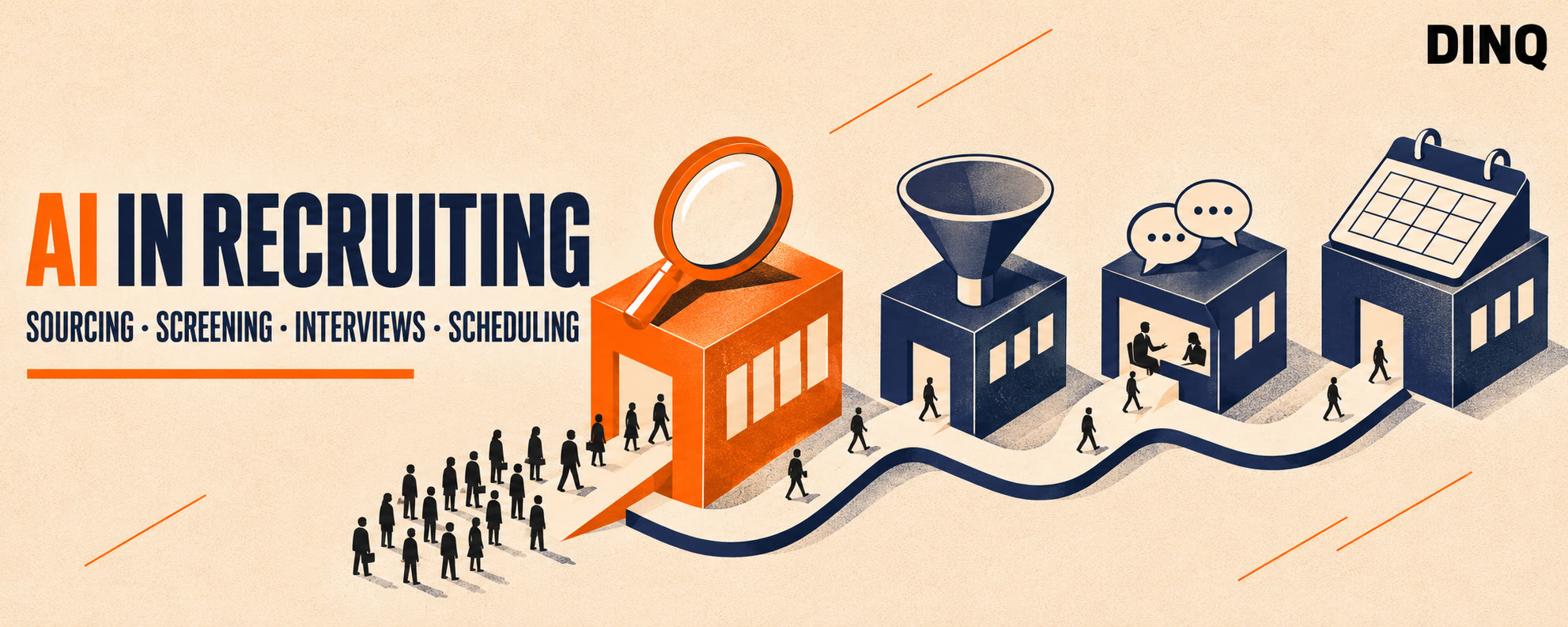
AI in recruiting means using software that learns from data and works with language to do parts of the hiring process: finding candidates, screening applicants, running first interviews, scheduling, and writing job posts and messages. Recruiters still decide who gets hired. In most teams, AI takes over the steps with the most volume and repetition, so people can spend their time on judgment and conversations.
This guide explains where AI fits in each stage of hiring, what an "AI recruiter" actually does (there are four quite different kinds), the risks and rules to know, and how to start. DINQ publishes this guide and is one of the tools in it: an AI recruiting platform in the sourcing category. Every vendor description below comes from that vendor's own website, checked on 26 November 2026.
Why recruiting teams are adopting AI
The pressure is volume. Greenhouse's 2026 hiring benchmark report, The Hire Standard, found that between 2022 and 2025:
- applications per role rose by 111%,
- the number of recruiters per organization fell by 56%,
- time to fill a role rose by 37%.
Candidates use AI too, to rewrite resumes and apply to more jobs faster, which pushes application counts higher still. More applications, fewer recruiters and slower hiring is the gap AI tools are sold to close.
Where AI fits in the hiring process
| Stage | What AI does | What still needs a person |
|---|---|---|
| Planning and job posts | Drafts job descriptions, suggests requirements, analyses hiring needs | Agreeing what the role really needs with the hiring manager |
| Sourcing | Searches profiles and the web for people who match a brief, ranks them and explains why | Deciding who is worth contacting, and building the relationship |
| Outreach | Drafts personal messages, runs follow-up sequences, finds contact details | Tone, timing, and anything sensitive |
| Screening | Reads applications, scores them against criteria, runs knock-out questions | Reviewing borderline cases, checking for unfair patterns |
| Interviews | Runs first-round chat, phone or video interviews; records and summarises interviews | Final interviews, assessing fit and potential |
| Scheduling | Books interviews across calendars, sends reminders, answers candidate questions | Exceptions and last-minute changes |
| Decision | Summarises evidence and feedback in one place | The hiring decision itself |
Most tools cover two or three of these stages. A few now try to run the whole sequence, from job description to booked interview, as one "agent".
What does an AI recruiter do?
"AI recruiter" is used for four kinds of software that do very different jobs. When you shortlist tools, first decide which job you need done.
1. Sourcing: finding people
A sourcing AI recruiter takes a description of the person you need, searches large pools of profiles or the open web, and returns a ranked list of candidates, often with the reasons each one matches. This is the work a human sourcer does before anyone has applied.
| Tool | What it says it does |
|---|---|
| Juicebox | "The AI Recruiting Platform that learns how you search", with agents that source around the clock |
| SeekOut | Find and engage candidates across 1B+ profiles and your ATS |
| Noon | An autonomous AI recruiting agent that sources, screens and reaches out to candidates |
| Pin | AI sourcing across 850M+ profiles, with outreach and scheduling in the same product |
| DINQ | Finds engineers and researchers by their work: code, papers, projects (our product) |
Where DINQ fits. DINQ is an AI recruiter for sourcing. You describe the role in plain language; DINQ turns it into an editable search plan, searches 1B+ professionals across 500+ data sources, from public profiles on GitHub, Google Scholar and LinkedIn to personal websites, checks each candidate against every criterion and shows the evidence behind each match: repositories, papers, talks and other public work. It covers 1,000+ universities and labs, which matters for AI and research roles. It also finds email addresses and drafts outreach. DINQ does not screen inbound applicants, run interviews or schedule them, so it sits next to the tools in the other three groups, not in place of them.
2. Screening: reviewing applicants
Screening tools work on people who have already applied. They read resumes, score them against the job's criteria, ask knock-out questions, and flag fake or AI-generated applications.
| Tool | What it says it does |
|---|---|
| SeekOut Applicant Evaluation & AI Screening | Evaluates every applicant, screens with AI and flags signs of fraud |
| hireEZ | Applicant review with AI matching that shortlists the best fit, on top of your ATS |
| CloudApper AI Recruiter | Candidate screening, scoring and scheduling for high-volume hiring |
| Puck | Phone-screens every applicant, on demand, around the clock |
3. Interviews: first-round conversations
AI interviewers hold the first conversation with a candidate by chat, phone or video, ask structured questions, and send the recruiter a summary and score. A related group records and summarises interviews run by people.
| Tool | What it says it does |
|---|---|
| Alex | AI interviews by video and phone, plus resume screens and scheduling |
| Ribbon | AI interviews for frontline hiring, with invites and outreach by SMS, email and WhatsApp |
| HireVue | AI Interviewer, video interviewing and validated assessments |
| Metaview | Interview notes, scorecards and follow-ups, plus sourcing and outreach agents |
4. Scheduling: booking the interviews
Scheduling tools coordinate calendars for candidates and interview panels, send reminders and answer routine questions by text or chat. They save a lot of coordinator time in high-volume hiring.
| Tool | What it says it does |
|---|---|
| GoodTime | Single-day, multi-day and panel interview scheduling |
| Paradox | Conversational scheduling and two-way messaging for frontline hiring |
| Sense | AI recruiter for sourcing, screening and interview scheduling alongside your ATS |
End-to-end "AI recruiting agents"
Some vendors now sell one agent across several of these stages. Pin goes "from job description to booked interviews". hireEZ describes agents that "source, review, screen and schedule". Metaview calls itself an agentic recruiting platform to "source, engage, and hire" end to end. If you consider one of these, check how well it does the stage you care about most, rather than how many stages it lists.
AI recruiter vs. human recruiter
An AI recruiter is fast and tireless on narrow, repeatable tasks: searching millions of profiles, reading a thousand applications the same way, or offering interview slots at 2am. A human recruiter does what those tools can't do reliably: understand what a hiring manager actually needs, persuade a passive candidate, read a conversation, close an offer, and take responsibility for a decision.
In practice the question is not "AI or recruiter" but which steps a recruiter hands to software. The teams that get the most from AI use it to see more candidates and spend more of their own time with the right ones.
Risks and rules
Bias. A model trained on past hiring decisions can repeat their patterns at scale. Screening and ranking tools need regular checks of who they pass and who they reject.
Candidate trust. Greenhouse's 2026 AI in Hiring report found that 42% of job seekers say their trust in the hiring process has declined because of AI. Tell candidates where AI is used, and keep a person reachable.
Fraud. AI also helps candidates fake applications. In a Greenhouse survey, 91% of recruiters said deceitful applications had affected them, and 34% spend up to half a week sorting spam applications.
Laws. Two rules recruiters ask about most:
- New York City, Local Law 144. Employers and agencies may not use an automated employment decision tool unless it has had a bias audit within the past year, a summary of the audit is public, and candidates have been given notice. Enforcement began on 5 July 2023 (NYC DCWP).
- EU AI Act. AI systems used to recruit or select people, including placing targeted job ads, filtering applications and evaluating candidates, are listed as high-risk in Annex III. The EU has been revising when the high-risk obligations take effect, so check the current dates before you rely on them.
Other US states and countries have their own rules on automated hiring decisions and candidate data. If a tool makes or shapes a decision about an applicant, involve your legal team.
Data. Read where a tool gets its candidate data and how it handles personal data, especially for candidates in the EU and UK.
How to start using AI in recruiting
- Pick the bottleneck. Too few good candidates points to sourcing. Too many applications points to screening. Too much calendar work points to scheduling.
- Write down what "good" looks like for one real role before you test anything: must-haves, nice-to-haves, deal-breakers.
- Test on that live role. Run the same brief through two or three tools and through your current process. Compare the shortlists, not the demos.
- Keep a person on every decision that rejects or advances a candidate, and log why.
- Check fairness and compliance before scaling: audit outcomes, tell candidates, and confirm local rules.
- Measure what changed: time to a qualified shortlist, response rates, time to fill and hiring manager satisfaction.
FAQ
What is AI in recruiting? It is the use of AI software in hiring: searching for candidates, screening applications, running first interviews, scheduling and drafting job posts and messages. People still make the hiring decisions.
What does an AI recruiter do? It depends on the kind. Sourcing AI recruiters find and rank candidates who haven't applied. Screening tools review applicants. AI interviewers run first-round chat, phone or video interviews. Scheduling tools book interviews and answer candidate questions. Some products combine several of these.
Will AI replace recruiters? Not the parts of the job built on judgment and relationships: understanding the hiring manager, persuading candidates, closing offers and owning decisions. AI is taking over repetitive work such as searching, first-pass screening and scheduling.
Is it legal to use AI in hiring? Yes, with conditions that vary by place. New York City requires a yearly bias audit and candidate notice for automated employment decision tools. The EU AI Act treats recruitment AI as high-risk. Check the rules where you and your candidates are.
What is the best AI tool for recruiting? There isn't one for every stage. Choose by the bottleneck: a sourcing tool if you lack candidates, a screening tool if you have too many applicants, an interview or scheduling tool if coordination is the problem. For sourcing tools, see our comparison of the best AI sourcing tools.
Is DINQ an AI recruiter? DINQ is an AI recruiting platform for sourcing: it finds and ranks engineers and researchers by their public work and shows the evidence. It does not screen applicants, interview or schedule.
Sources
Checked on 26 November 2026.
- Greenhouse: What is artificial intelligence in recruitment?, citing The Hire Standard 2026 benchmark report and the 2026 Greenhouse AI in Hiring Report
- IBM: AI in recruiting
- NYC Department of Consumer and Worker Protection: Automated Employment Decision Tools
- EU AI Act: Annex III, high-risk AI systems
- Vendor websites linked in each table above
Related reading
- Best AI sourcing tools for recruiters in 2026
- LinkedIn Hiring Assistant: what it is, plans and limits
- People search MCP: use a talent search engine from your AI agent
To see what a sourcing AI recruiter finds for one of your open roles, try a search on DINQ.