DINQ January Launch Recap
One week in, and the signal is already global.
On January 12, DINQ officially launched worldwide. We simply opened the doors and watched what happened. What followed was faster, broader, and more global than we expected.
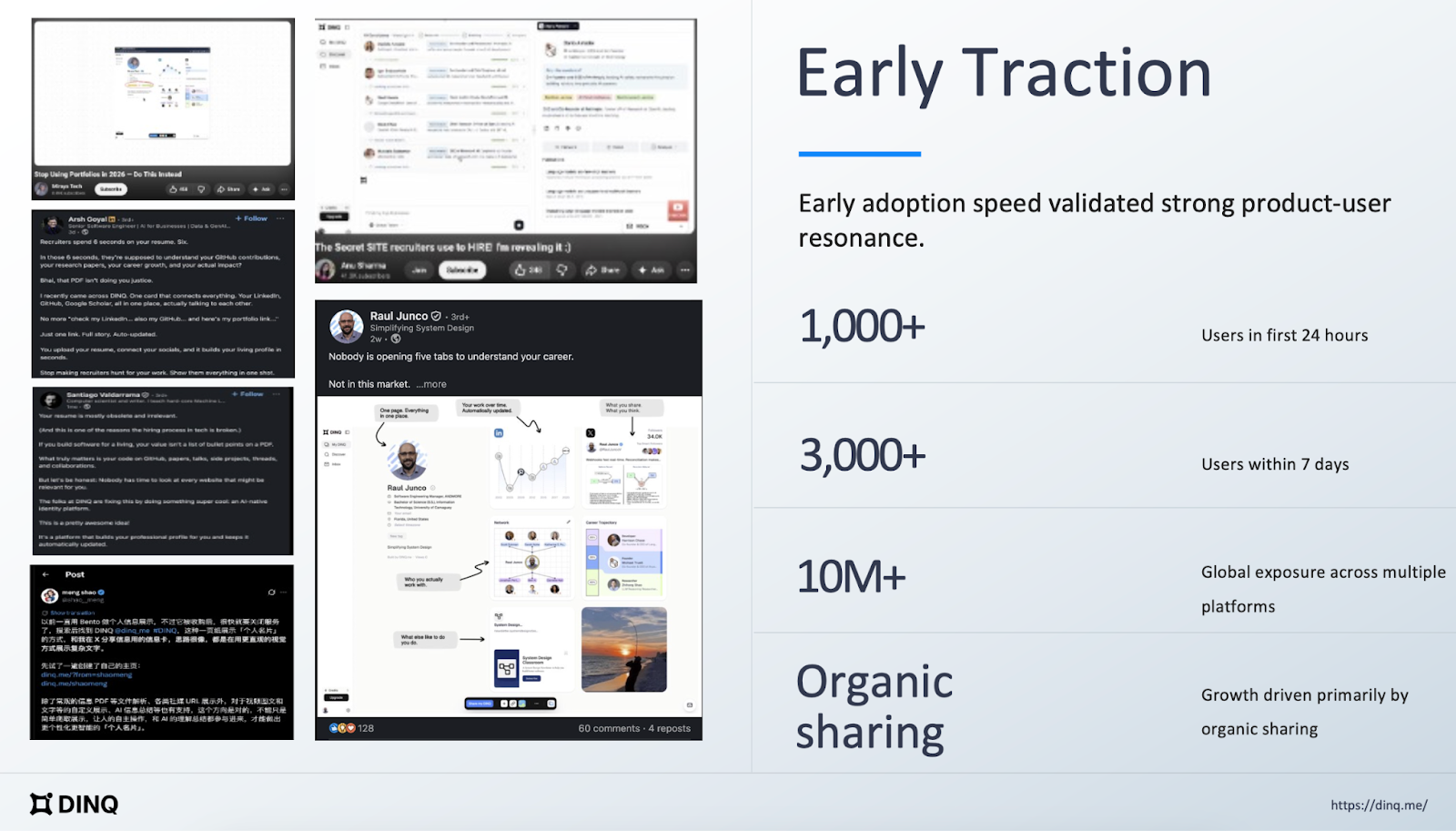
From zero to 3,000+ users in one week
Within 24 hours of launch, DINQ crossed 1,000 registered users. By the end of the first week, that number exceeded 3,000.
More importantly, these users did not come from a single platform, region, or role. They arrived from different countries, different time zones, and very different professional contexts.
They started sharing DINQ organically across X, LinkedIn, and other communities. Creators, builders, and researchers shared their DINQ Cards, workflows, and use cases. The combined reach exceeded 10 million impressions within the first week.
Who joined DINQ in week one
AI and technology companies
Early adopters included professionals from leading global AI and technology organizations, including:
- Meta
- Microsoft
- Amazon
- NVIDIA
- Oracle
- xAI
- OpenAI
- Manus AI
- Moonshot AI
- DeepSeek
- Alibaba
- Tencent
- ByteDance
- Baidu
- Kuaishou
- Xiaomi
- JD
- Huawei
These users were not coming to "try a new tool." They were looking for a clearer way to present real work, real signals, and real collaboration intent.
Traditional industries and global enterprises
DINQ was also adopted by professionals outside the AI bubble, including teams from:
- IKEA
- Booking.com
- Shopee
- Ubisoft
- Stripe
- Bank of America
- Visa
- AT&T
- PwC
- Boeing
- Samsung
- Accenture
This diversity reinforced something we believed early on: the problem DINQ addresses is not industry-specific, but structural.
Researchers, labs, and universities worldwide
A significant portion of early users came from academic and research communities. Researchers from the following labs and institutions joined DINQ during the launch week:
- Shanghai AI Laboratory
- California Center for Population Research (CCPR), UCLA
- Natural Language Processing Lab, Tsinghua University
- Berkeley Artificial Intelligence Research Lab (BAIR)
- Zhejiang University
- Shanghai Jiao Tong University
- University of the Chinese Academy of Sciences
- Sun Yat-sen University
Alongside researchers and students from universities including:
- Cornell University
- University of Pennsylvania
- University of Illinois Urbana-Champaign
- Northwestern University
- Columbia University
- UC Berkeley
- The University of Texas at Austin
- Carnegie Mellon University
- MIT
- University of Oxford
- National University of Singapore
- Peking University
- The Chinese University of Hong Kong
- Tsinghua University
- Fudan University
- Tongji University
For many of them, DINQ became a way to consolidate publications, projects, and collaboration signals into something searchable.
What this launch told us
The January launch was not just about numbers. It validated something deeper:
- People are tired of fragmented professional identities.
- Resumes do not travel well across platforms, roles, or borders.
- Real work is hard to discover, even when it exists.
DINQ resonated because it asked people to put the facts in one place.
What's next
January was only the starting point. Since launch, we have continued refining our existing features, guided directly by how early users are using DINQ in the wild.
At the same time, we are actively developing new features to address the growing number of specialized roles, use cases, and unmet needs emerging across different communities and markets.
When real work becomes visible, the right connections follow. We are building for that future in public.